One Small Tool, Infinite Consistency: The Jigger Guide Every Home Bartender Actually Needs
Here's something most home bartenders won't admit: they're guessing. Every pour, every splash, every "that looks about right" is a small gamble that compounds into a drink that tastes slightly different every time. Some nights the Old Fashioned is perfect. Other nights it's a little flat, a little sharp, a little off — and you can't quite put your finger on why.
The answer is almost always measurement. And the fix is almost always a jigger.
This isn't a lecture. It's a practical breakdown of one of the most underappreciated tools behind any well-run bar — professional or home — and why investing five minutes in understanding it will pay off every time you shake or stir.
What a Jigger Actually Is (And Why It's Not Just a Cup)
At its most basic, a jigger is a double-sided measuring tool used to portion spirits and modifiers before they go into a drink. The classic hourglass shape gives you two measurements — typically 1.5 oz on one side and 0.75 oz on the other, though variations are everywhere.
But calling it just a measuring cup misses the point. In a professional bar environment, the jigger isn't only about accuracy — it's about building a physical routine. Bartenders who jigger consistently aren't stopping to think about how much they're pouring. They've trained their hands and eyes to work together in a fluid motion that becomes second nature. The measurement happens almost automatically.
That's what you're actually chasing at home: not just precision, but the kind of practiced ease that makes the whole process feel effortless.
The Different Styles (And Which One Belongs in Your Home Bar)
Not all jiggers are built the same, and the style you choose actually matters for how comfortable the technique feels.
The Japanese Jigger is the sleek, elongated version you've probably seen in craft cocktail bars. It's tall, narrow, and elegant — and that narrowness is a feature, not a style choice. A thinner vessel is easier to fill precisely to the top without overflow, which is where accuracy actually comes from. If you're serious about your home bar, this is the one to get.
The Classic American Jigger is the short, stout hourglass shape that's been around for generations. It's sturdy, easy to grip, and widely available. The measurement markings aren't always as precise, but for most home use, it gets the job done without fuss.
Stepped Jiggers feature interior measurement lines at multiple levels — 0.5 oz, 0.75 oz, 1 oz, 1.5 oz, and sometimes 2 oz — all within a single vessel. These are genuinely useful for home bartenders who work with a wider range of recipes. Less swapping, more flow.
For most people setting up a home bar from scratch, a good Japanese-style jigger paired with a stepped jigger covers virtually everything. Spend $15–$25 total and you're well equipped.
The Right Way to Use One (Because There Is a Wrong Way)
Here's where most people stumble. They pull out the jigger, pour in the spirit, then hover it over the glass and sort of tip it in. It works, but it's clunky — and clunky slows you down and breaks the rhythm of making drinks.
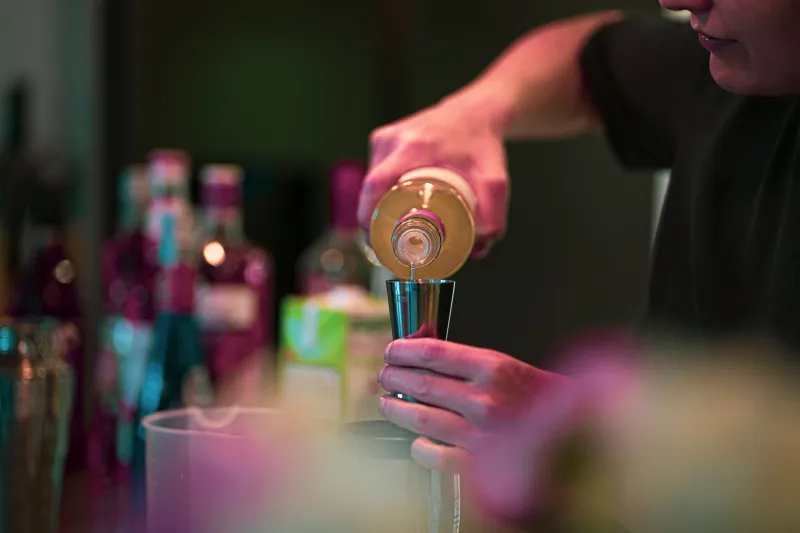
Professional technique is different. The jigger stays close to the mixing glass or shaker at all times. You fill it to the brim — not almost to the brim, to the brim — and you pour in a single, confident arc. The motion is smooth, deliberate, and quick. No hesitation.
Filling to the absolute top is the key detail most people miss. A jigger half-filled to a line is less accurate than a jigger filled completely to the rim of one of its sides. Surface tension will hold a small dome of liquid at the top without spilling, and that full-to-the-top pour is where the precision actually lives.
Practice this with water first. Seriously. Fill the jigger with water, pour it cleanly into a glass, and do it ten times in a row. You're not just learning the motion — you're building muscle memory that will eventually let you jigger without thinking about it.
Why Muscle Memory Changes Everything
There's a psychological component to all of this that doesn't get talked about enough. When you reach for a jigger and move through the measuring process automatically, something shifts in how you approach the entire drink. You stop being reactive — guessing, adjusting, second-guessing — and start being intentional.
That shift changes the quality of your drinks in ways that go beyond measurement. You pay more attention to your other ingredients. You notice when something smells off. You're present in the process instead of rushing through it.
Consistency is also the thing that lets you improve. If every drink is slightly different because your pours vary, you can never accurately tell whether a recipe tweak is working or whether you just happened to pour a little more vermouth this time. A jigger gives you a controlled baseline. From there, adjustments become meaningful.
The Argument Against Expensive Spirits (At Least Right Now)
Here's a counterintuitive take: if you're currently eyeballing your pours, upgrading to a premium spirit isn't going to help you as much as you think. The flavor difference between a $30 bottle and a $60 bottle matters less than whether you're using consistent ratios.
A well-measured cocktail made with a mid-shelf spirit will almost always taste better than a sloppy pour made with top-shelf booze. The jigger is the foundation. Get that right first, then start exploring better bottles.
That's not a knock on quality spirits — they absolutely matter. But the sequence matters too. Build the technique, then build the collection.
A Note on Freepouring (And Why It's Not for Home)
Freepouring — counting seconds as you pour without a jigger — is a real skill used in high-volume bars where speed is the priority. It works when someone has poured thousands of drinks and calibrated their count against their specific pour spout flow rate. It does not work reliably for the home bartender making drinks a few times a week.
The math is unforgiving. A half-second difference in your count can mean a quarter ounce off, which in a three-ingredient cocktail is enough to throw the whole balance. Skip freepouring at home. It's a bar trick, not a craft.
The Bottom Line
A good jigger costs less than a single cocktail at most bars in this country. It takes about a week of casual practice to start using it fluidly. And it will do more for the overall quality of your home bar than almost any other single investment you can make.
Get one. Fill it to the top. Pour with confidence. Then notice how much better your drinks taste when they're the same every single time.